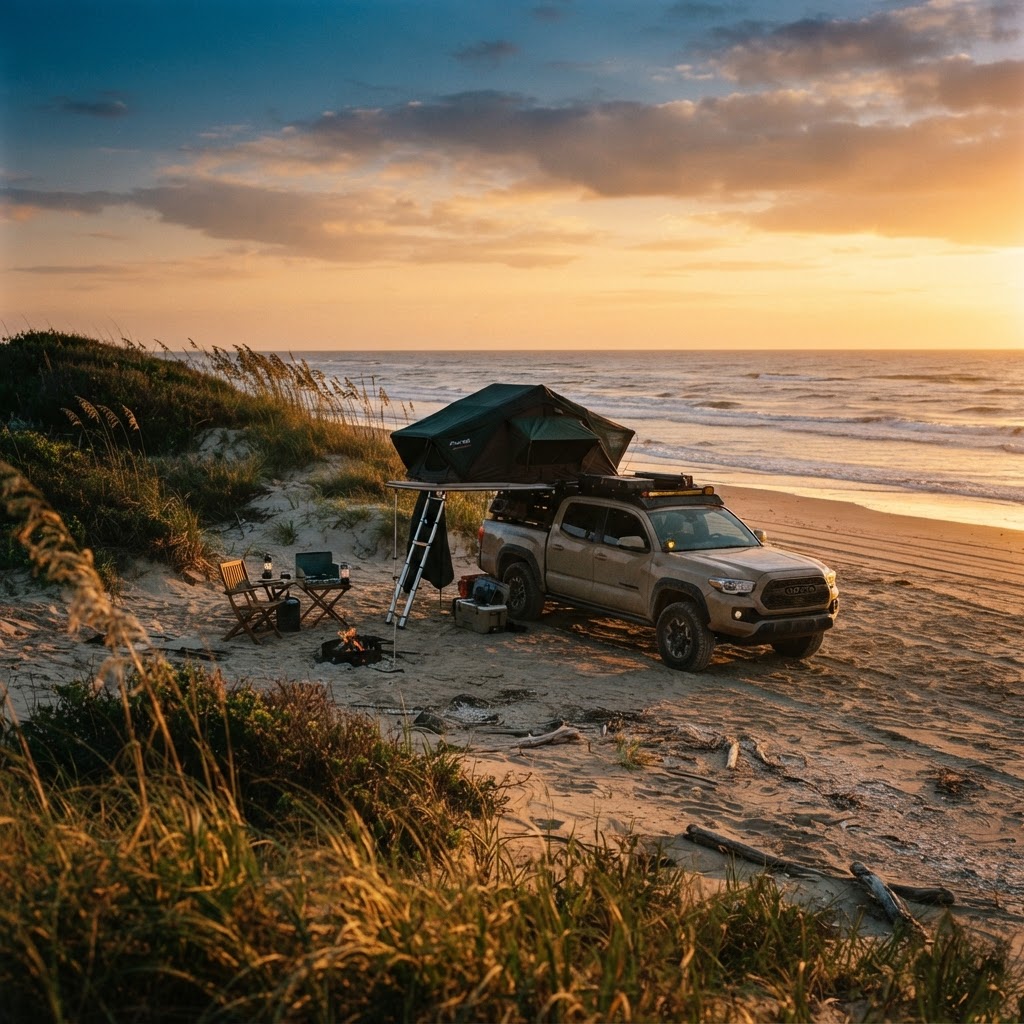
There's a specific kind of silence that happens when you camp on a beach at night. It's not really silence at all — it's the rhythmic crash of waves, the whisper of wind through sea oats, and the occasional call of a night heron. But compared to the noise of the world you left behind, it's the quietest place on earth.
Now imagine waking up to that sound, stepping out of your rig, and watching the sun rise over the Atlantic from the exact spot where you parked your truck — no campground, no neighbors, no check-in desk. Just you, your vehicle, and miles of empty sand.
That's overland beach camping. And it's exploding.
The "Dirt Flirts" movement on Pinterest — a celebration of rugged, self-sufficient vehicle travel — has merged with the coastal lifestyle to create a new breed of adventure traveler: people who want the overlanding experience but don't want to be 100 miles from the nearest ocean. They want to air down their tires, drive onto the sand, set up camp, and fall asleep to the sound of the tide.
Here's your complete guide to making it happen — safely, legally, and with the right gear.
What Is Overland Beach Camping?
Overland beach camping is exactly what it sounds like: using a 4WD vehicle to access remote beach areas where vehicle camping is permitted, then setting up a self-sufficient camp on or near the sand.
It sits at the intersection of three trends:
- Overlanding — self-reliant vehicle travel to remote destinations
- Beach camping — sleeping on or near the coast
- Off-road beach access — driving on permitted beaches with a 4WD vehicle
The result is a style of camping that combines the self-sufficiency and vehicle-modification culture of overlanding with the soul-restoring magic of sleeping next to the ocean.
Where Can You Legally Camp on the Beach?
This is the most important question, and the answer varies dramatically by location. Beach driving and overnight camping are heavily regulated — you can't just pull onto any beach and pitch a tent. Here are the best legal options in the US:
Padre Island National Seashore, Texas
The crown jewel of beach camping in the US. 60 miles of drivable beach with no development, no paved roads, and designated primitive camping areas. You can drive as far south as the Mansfield Channel (about 60 miles) and camp anywhere along the way. The farther you drive, the more remote it gets.
- Permit required: Yes — entrance fee + free camping permit
- 4WD required: Recommended (2WD is possible in dry conditions but risky)
- Best season: October–April (summer is brutally hot and buggy)
- Amenities: None past the first 5 miles. Pack everything in, pack everything out.
Ocracoke Island, North Carolina (Outer Banks)
Designated beach camping is available at the Ocracoke Campground (NPS), but for the true overland experience, 4WD beach access is available at the north end of the island. No driving on the beach at night, but you can set up near the ORV ramps.
- Permit required: ORV permit required for beach driving
- 4WD required: Yes
- Best season: September–November, April–May
Cape Hatteras National Seashore, North Carolina
Multiple ORV ramps along Hatteras Island allow beach driving with a permit. Overnight camping on the beach itself is not permitted, but several oceanside campgrounds are accessible via 4WD routes.
- Permit required: ORV permit ($50/week or $120/year)
- 4WD required: Yes
- Best season: Fall and spring
Assateague Island, Maryland/Virginia
One of the few East Coast beaches where you can camp right on the sand with your vehicle. Over-sand vehicle (OSV) zone allows 4WD access to 12 miles of beach. Camping is in designated areas only.
- Permit required: OSV permit ($80–$165/year)
- 4WD required: Yes
- Best season: September–October (avoid summer — it's packed)
Crystal Beach, Texas (Bolivar Peninsula)
Free beach camping on the Gulf. No permit required for driving or camping on the beach. Bring your own everything. Wild, wide-open, and gloriously unregulated (within reason).
- Permit required: No
- 4WD recommended: Yes (especially in soft sand)
- Best season: October–April
Vehicle Preparation: Getting Beach-Ready
Your daily driver is not ready for beach camping. Here's what you need:
Tires
- Aired down to 15–20 PSI (down from 35 PSI on pavement). This increases the tire's contact patch and prevents you from sinking. Carry a portable air compressor to reinflate before hitting the highway.
- All-terrain or mud-terrain tires are strongly recommended. Street tires will get you stuck.
Recovery Gear
Every beach vehicle should carry:
- A recovery strap (snatch strap) — not a tow strap. There's a difference.
- D-rings/shackles — for attaching the strap to recovery points
- A shovel — a real one, not a folding camp trowel. When you get stuck in sand, you dig.
- Traction boards (Maxtrax or similar) — place under your tires to get unstuck
- A tire pressure gauge — a good one, not the gas station special
Camp Gear
- A roof-top tent (RTT) or ground tent with sand stakes (regular tent stakes are useless in sand)
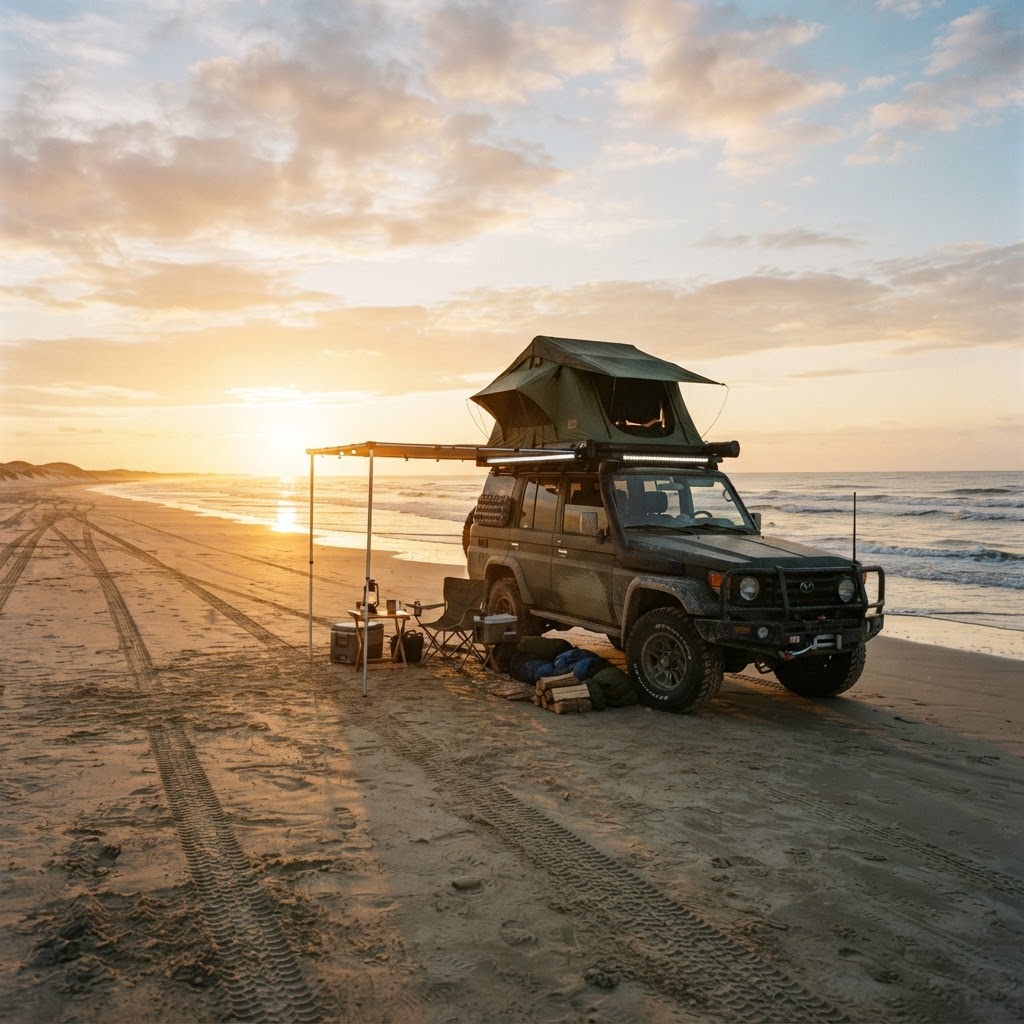
- A portable shade structure — there are no trees on the beach. Sun exposure is real.
- A good cooler — 5+ days of ice retention minimum. There's no ice machine 40 miles down the beach.
- LED camp lights or lanterns
- A portable camp table
Water
Bring more water than you think you need. Rule of thumb: 2 gallons per person per day for drinking, cooking, and basic cleaning. On the beach, you'll drink more than you think.
The Beach Camping Experience: What to Expect
The Drive In
The first time you drive on sand, it's nerve-wracking. The vehicle feels different — the steering gets vague, the tires want to wander, and every soft patch looks like a trap. Here's the key: momentum is your friend. Keep a steady speed (15–25 mph), don't stop in soft sand, and don't make sharp turns. If the tires start to dig in, straighten out and keep moving.
Setting Up Camp
Once you've found your spot (at least 50 feet from the dunes — dunes are protected and fragile), park, set the parking brake, and start setting up. Priority order:
- Shade first — the sun is relentless. Get your awning or shade structure up before anything else.
- Then the tent/sleeping setup — RTTs go up in 2 minutes. Ground tents need sand stakes (or buried stuff sacks filled with sand).
- Then the kitchen — a portable table with your stove and cooler. Keep food sealed — seagulls are aggressive and fearless.
The Evening
This is the payoff. After the sun drops, the beach transforms. The air cools. The stars come out — and on a remote beach with zero light pollution, the Milky Way is so bright it casts shadows.
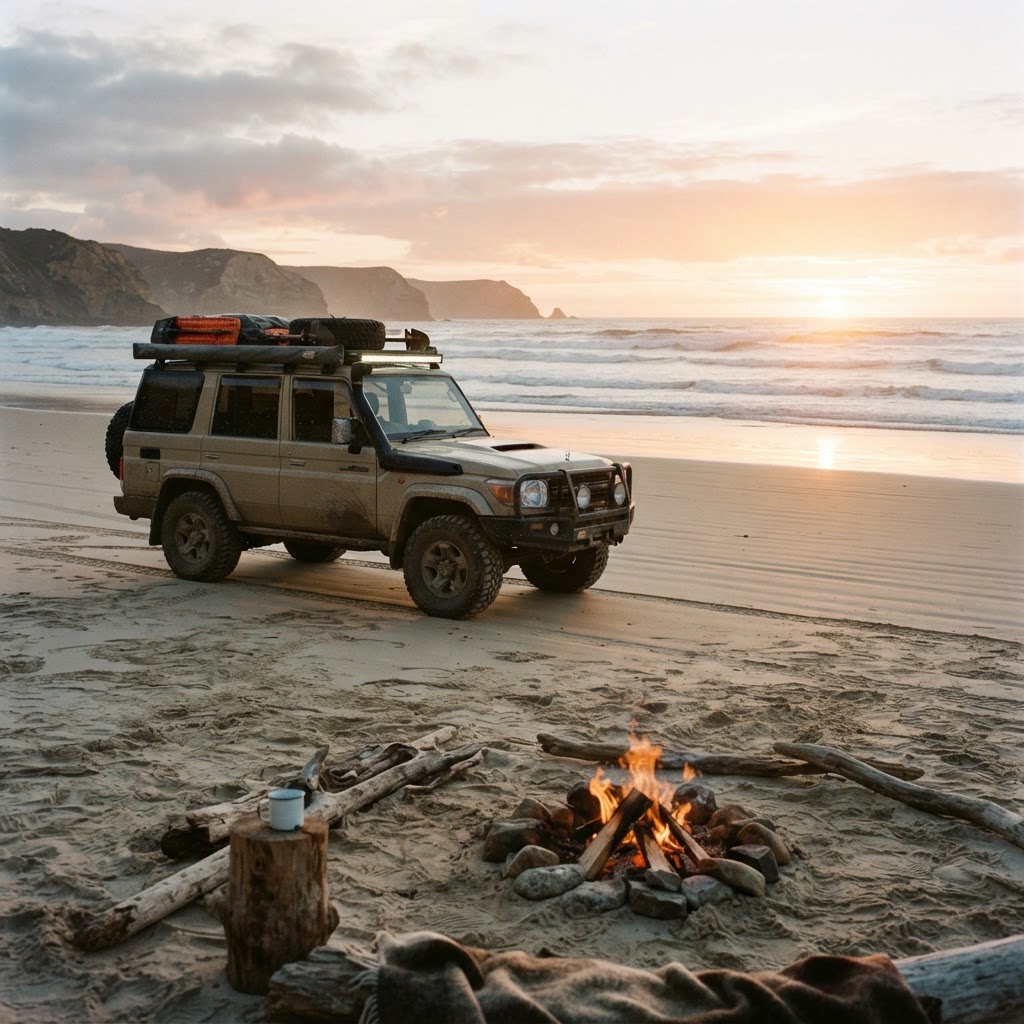
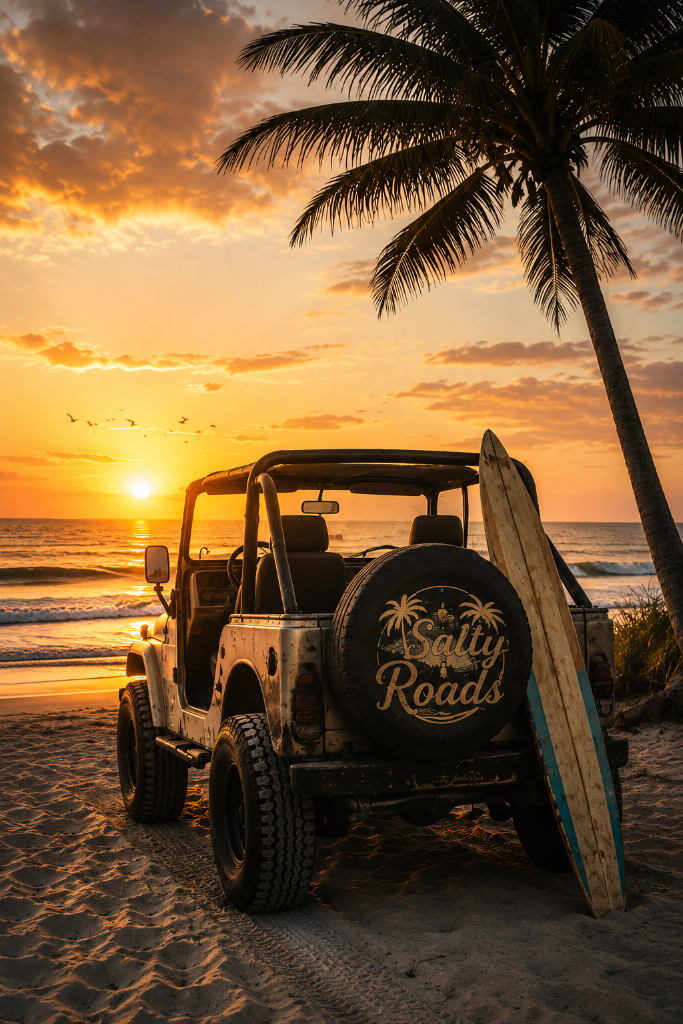
Build a fire if permitted (check local regulations — many beaches require a fire pan, not a ground fire). Crack open a cold one. Pour it into your Off-Road Tropical Sunset Beer Pint Glass — because you drove 40 miles down a beach to get here, and you deserve proper glassware. Pull on your Salty Roads Kraken's Revenge T-Shirt as the evening chill sets in, and let the waves do their thing.
The Morning
Wake up before sunrise. Seriously. Pour coffee from your camp stove, walk to the waterline, and watch the sun come up over an empty beach. This is the moment that makes all the prep, the gear, the sand in everything, and the long drive worth it.
Leave No Trace: Beach Camping Ethics
Beach camping is a privilege that can be revoked at any time. Every piece of trash left on a beach is an argument to close it to vehicles. Here's the deal:
- Pack out EVERYTHING. Including food scraps, cigarette butts, and fire ash.
- Fill in any holes you dig (including fire pits and vehicle ruts).
- Stay off the dunes. They're protected by law and are critical for coastal protection.
- Keep your distance from wildlife. Sea turtles nest on these beaches. Birds nest in the dunes. Your campsite is in their home.
- Don't drive above the high tide line unless specifically permitted.
- If you packed it in, pack it out. Period.
What Not to Do
We've seen it all on the beach. Here's what NOT to do:
- Don't camp below the high tide line. You will wake up in the ocean. Check the tide chart.
- Don't drive in 2WD on soft sand. You will get stuck. And when the tide comes in...
- Don't bring glass to the beach. Broken glass on a beach is a sin. Use your metal or enamel drinkware. (Your Salty Roads pint glass is technically glass, so enjoy it at camp and keep it away from the surf zone.)
- Don't feed the wildlife. Seagulls become aggressive when fed, and it's harmful to their health.
- Don't ignore weather. Coastal storms can roll in fast. Have an exit plan.
The Best Beaches for Your First Overland Beach Camping Trip
If you're new to this, start somewhere manageable:
- Padre Island National Seashore, TX — The best beginner-to-expert progression. Camp at Mile 5 the first time, push farther as you gain confidence.
- Assateague Island, MD — Well-regulated, beautiful, and you get to see wild horses. A great East Coast starter.
- Crystal Beach, TX — No permits, no fees, no rules (within reason). A good place to test your gear and skills without commitment.
Final Thoughts
Overland beach camping is not for everyone. It requires preparation, the right vehicle, and a willingness to get sand in places you didn't know you had. But for those who do it, there's no going back to a crowded RV park with full hookups.
The beach at night — with nothing but stars, waves, and the faint glow of your campfire — is one of the last truly wild experiences available to the modern traveler. It's the kind of thing that recalibrates your soul.
So air down those tires, pack the cooler, grab the right gear, and point your rig toward the sand. The beach is calling, and it's got 60 miles of empty coastline waiting for you.
Just don't forget the recovery strap. 🏖️🚙