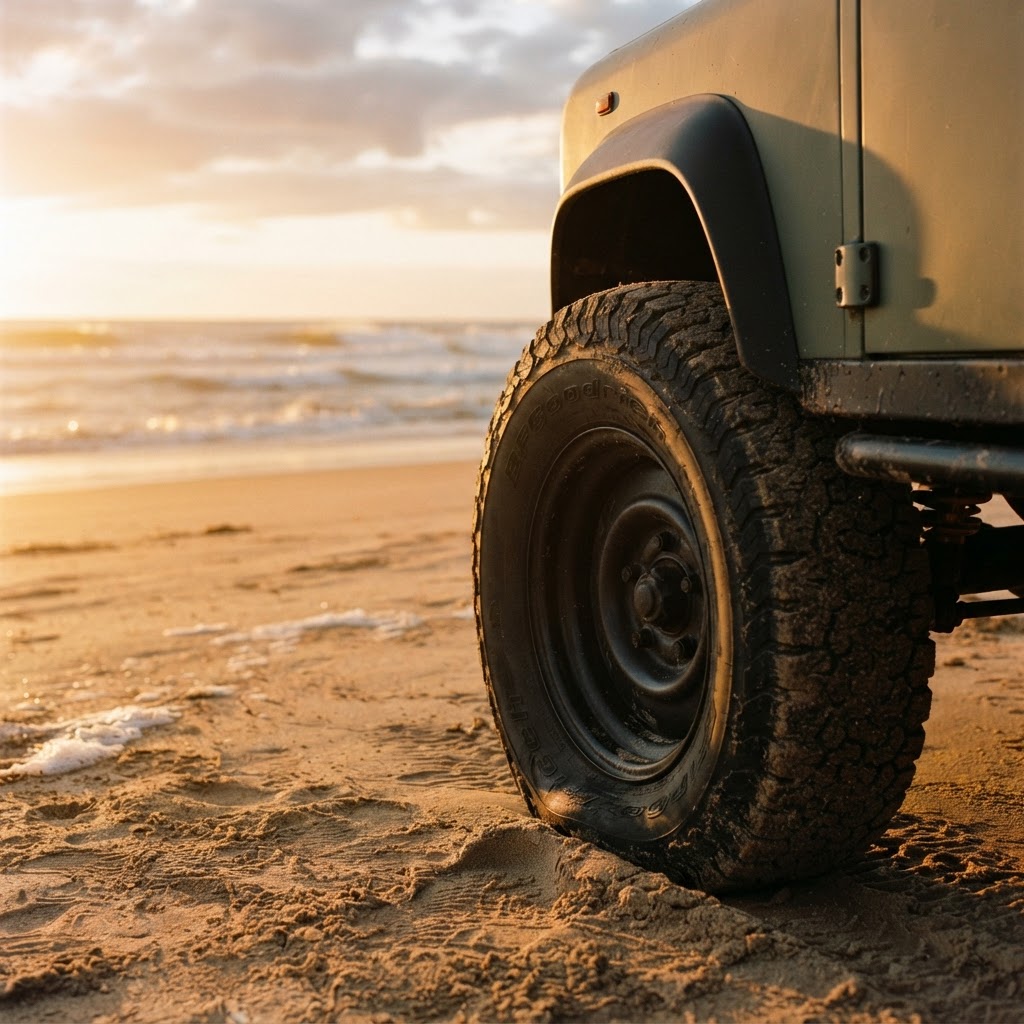
Nothing ruins a perfectly good beach day faster than the sickening crunch of your chassis bottoming out in a patch of soft, sugary sand. Whether you’re chasing the perfect break at Hatteras or scouting a hidden cove along the Baja peninsula, mastering the art of the air-down is the difference between an epic sunset tailgate and a four-figure tow bill.
The Physics of Flotation: Why Airing Down is Non-Negotiable
When you’re driving on asphalt, you want your tires stiff to minimize rolling resistance and heat buildup. On the sand, however, the physics flip. If your tires are pumped to highway pressure—usually 35 to 44 PSI—your vehicle essentially acts like a dull knife edge, carving a deep trench into the dunes rather than gliding over them.
By airing down, you increase the tire's "contact patch." Think of it like wearing snowshoes instead of stilettos. As the pressure drops, the sidewall flexes, the tread flattens out, and the tire gains the ability to "float" on top of the sand grains rather than digging in. This isn't just about avoiding a stuck rig; it’s about protecting the beach ecosystem. Ripping through the dunes because you’re over-inflated leaves deep ruts that accelerate erosion and ruin the terrain for everyone else. Proper pressure keeps your rig moving smoothly and shows respect for the coastal environment we all love to explore.
What PSI for Beach Driving? 2026 Pressure Guidelines
For most standard 4x4s, SUVs, and Jeeps, the sweet spot for beach driving sits between 15 and 20 PSI.
However, "sand" isn't a monolith. Here is how you should adjust based on the conditions you’re facing:
- Firm, Wet-Packed Sand (The "Hardpack"): If you’re driving on the tideline at low tide, you can usually get away with 20 to 22 PSI. You’ll have enough flotation to handle minor soft spots, but you won’t be overheating your tires on the harder sections.
- Deep, Sugar Sand (The "Inland Dunes"): When you’re heading up the dunes to find a secluded spot, drop to 15 PSI. If the sand is particularly loose or sun-scorched, don’t be afraid to go down to 12 or 13 PSI. Pro Tip: If you go below 15 PSI, you must drive slowly. Sudden steering maneuvers at very low pressures can cause the tire to peel off the bead—a headache you don’t want when the tide is coming in.
- Heavy Loads/Trailer Towing: If your Jeep is loaded down with coolers, surfboards, and gear, add 2-3 PSI to your baseline to ensure you don't lose that vital sidewall stiffness.
Always remember: if you start to feel the vehicle bogging down, stop immediately. Don’t floor it. Your best bet is to back up in your own tracks and take a second look at your tire pressure gauge.
Quick Drops: The Best Automatic Tire Deflators for 2026
Fiddling with valve caps and manual gauges while the sun is beating down is a quick way to lose your cool. In 2026, the tech has caught up to the demands of the off-road community. Automatic tire deflators are a "set it and forget it" solution that every beach-goer should carry in their recovery bag.
The best systems currently on the market allow you to screw the deflator onto the valve stem, where it automatically stops the flow of air once it hits your pre-set PSI. Look for models with a lock-ring that stays consistent even when coated in salt spray and grit.
If you’re waiting for your tires to reach 15 PSI, use that time to set up your chairs or pull out a Sunset Surf Run T-Shirt from your gear bag. By the time you’ve shifted into your favorite tee, your rig will be ready to tackle the dunes.
Re-Inflating on the Fly: Top Portable Air Compressors
Getting off the beach is only half the battle; driving 60 mph on the highway with 15 PSI in your tires is a recipe for a blowout and ruined rims. You need a high-volume portable air compressor that can handle the heat.
When shopping for a compressor, look for a "duty cycle" rating of at least 50%. This ensures the unit won’t thermal-cutout halfway through filling your fourth tire. I personally swear by twin-cylinder models that mount directly to your battery terminals. While the built-in compressors in some modern trucks are convenient, a dedicated portable unit often provides the speed required to get back on the pavement before the afternoon traffic hits.
Keep your compressor in a dry, ventilated box. After a long day of salt-air exposure, give the quick-connect fittings a quick freshwater rinse once you’re back home to prevent corrosion from locking up the release valve.
Sand Driving 101: Momentum, Ruts, and Essential Recovery Gear
Driving on sand is a dance, not a drag race. The golden rule is momentum management. Keep a steady foot on the throttle—you want enough power to keep moving forward, but not so much that your tires spin and dig holes.
- Follow the Ruts, Sometimes: If the ruts are wide and shallow, follow them; they’ve been compacted by other vehicles. If they are deep, jagged, and look like they’ve been carved by a heavy-duty truck, straddle them. Straddling ensures your differentials don’t high-center on the ridge between the tires.
- Avoid the "Soft Shoulders": The sand closest to the dunes is almost always softer and deeper than the sand near the water. If you’re parking, choose a spot where the sand looks slightly darker or has a firm, crusty texture.
- The Recovery Kit: Even with the perfect PSI, mistakes happen. Carry a set of traction boards (recovery tracks) and a heavy-duty kinetic recovery rope. Never use a metal chain for beach recovery; if it snaps, it becomes a lethal projectile.
Once you’ve successfully navigated your way to the perfect spot, it’s time for the reward. There’s nothing quite like pulling a Salty Roads™ - Dirty Roads & Cold Beer Pint Glass out of the cooler to toast to a successful beach arrival. It’s the small, ritualistic comforts that make the coastal lifestyle what it is.
The Pavement Rule: Airing Back Up for Highway Speeds
The transition from sand to pavement is where most people get lazy. It’s tempting to think, "I’m only five miles from the gas station, I’ll just drive slow." Don’t. Low-pressure tires on hot, dry asphalt are incredibly unstable. They squirm during cornering, braking distances increase exponentially, and you risk a catastrophic tire failure.
Follow these steps for a safe transition:
- Find a Staging Area: Look for a pull-off just before you hit the main road. If you try to air up on the shoulder of a busy highway, you’re putting yourself and your gear at risk.
- Clear the Sand: Briefly wipe off the valve stems to ensure a tight seal with your compressor hose.
- Check for Heat: If your tires were working hard in deep, hot sand, they might be hot to the touch. Re-inflating them will increase the internal pressure as they cool; re-check your pressures after 10 miles of driving once the air has stabilized.
- The Final Check: Once you’ve reached your target highway PSI, take a moment to change into your Salty Roads Island Escape T-Shirt. It’s the perfect way to transition from the raw, gritty reality of off-road recovery to the relaxed, post-beach mindset of the drive home.
Ultimately, beach driving is about accessibility. It’s about getting to that remote stretch of coastline where the surf is pumping and the crowds are non-existent. Respect the sand, keep your PSI in check, and you’ll find that the road less traveled is almost always the one worth taking. See you out on the dunes.